
|
Tour de Lance: A Tour de France 2004 replay dynasty
And now for something completely different....
Hello, all, and welcome to a potentially long-running, slow-paced dynasty that will replay the 2004 TDF using a tabletop game called "La Grande Boucle" (available here). This game has ratings for all riders in the 2004 Tour, mostly having to do with time trials, sprinting ability, and climbing ability, with special rules governing the use of each. While there are automated versions of the game available, I'll be doing this mostly by hand (though Excel will be a very large contributor in terms of tracking standings and adding some variety). I'm also doing the full experience, all 188 riders. Due to the nature of the game having its ratings tied specifically to this particular tour, a number of riders will drop out of the race as they really did, including such riders as Tyler Hamilton (who bailed during stage 13) and Ivan Mayo (who didn't come out for stage 15). The rules grant a little bit of leeway in case those riders are doing well when they are scheduled to drop, but for the most part, they should be exiting the stage on cue. The game creator has specified the type of stage each stage is (TT, flat stage, mountain stage) and has rules for governing each (attacks, breakaways, finishes, climbs, etc). However, I'll be adding to the game a little bit so I can keep accurate track of King of the Mountain and the Green jersey, along with Yellow and Team standings. For instance, the game doesn't credit KoM points for climbs rated 3 or 4, but I'll do it anyway, just using the bunched finish rules for climbs if no breakaway has occurred. Same for intermediate sprint points. Excel will be handling virtually all the math for me. I'll just roll the virtual dice (with my dice program) and see what comes up over the course of the race. As I said, this will be a long-term, low-impact, stop-and-start project. My goal is to finish by the time TDF 2005 comes around in July. It'll depend on the free time I can muster for it. I have a monster project coming in May at work and am not sure how much that will affect things. I'm trying to decide a good reporting format, especially for something like time trials, where the only specified detail is how much time it takes for a rider to finish, though there would be occasional trouble for most of the lesser riders. I'm thinking for at least the Prologue of identifying whenever a rider comes in first "for the moment" and also detailing the final times for those riders who are strongly rated for the trial (such as Armstrong). Any suggestions? As for regular stages, the nature of the game draws attention to certain events like breakaways and sprints, so I don't think it'll be too difficult to report the goings-on for those stages. I have already run the Prologue (did it a couple of days ago, but have been spending time tinkering with my Excel sheets to get the output I want). I will attempt to post results tonight or tomorrow. This should be interesting (and hopefully fun). :) |
My suggestion.. Eliminate Lance "Doping is my friend" Armstrong from the field :)
|
Interesting, I will be following along.
|
Quote:
 Edit : and I will follow |
Yay, another dynasty to read.
|
Quote:
:rolleyes: |
Well, seeing as this is a replay, IOW, a recreation of the actual event, Lance has to be in the event. Besides, his name's on the thread... ;)
Coming up, we'll head to Liege, Belgium and the start of the 2004 Tour with the uber-quick Prologue stage. The guys will barely get their hearts racing before it's over. |
Prologue--Liege, Belgium (July 3, 2004)
The action starts with the prologue on Saturday July 3, beginning in the centre of Liège, Belgium before winding along the River Meuse and then passing the Palais des Princes Eveques. This is a 6 km time-trial on a flat circuit and will test the riders aiming for a top ten, finishing in the in the beautiful Boulevard de la Sauvenière. Route map: 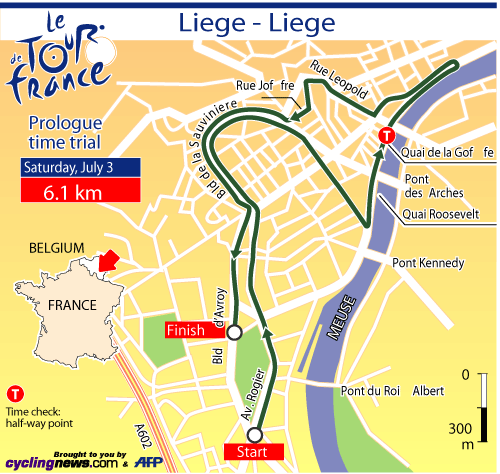 Route profile:  The first rider to be sent off in the Prologue will be Pierre Bourquenoud, a 34-year old rider from Switzerland and member of the RAGT Semences-MG Rover team at 4:01 PM. Defending champion Lance Armstrong of US Postal Service will make his 2004 debut as the last rider in the trial at 7:08 PM. |
4:01 PM
Pierre Bourquenoud (RAGT) departs the start line and the 2004 Tour is under way. 4:09 PM Bourquenord finishes his time trial in 8:00.52 to set the first benchmark for the riders following. It is a mark that will be easily beaten by a number of riders over the next 40 minutes. 4:48 PM Viatcheslav Ekimov (USPS) comes blazing into the finish, setting a new mark at 7:09.78, good for a momentary four-second lead. 4:51 PM Angel Vicioso (Liberty Seguros) departs the starting line and sets a strong pace. At the timecheck, he's well in front of Ekimov's time and looks like he will take the lead. 4:58 PM Vicioso's great trial run finishes and he has lowered the bar by a full seven seconds, finishing at 7:02.24. It should stand up for a while, but the best riders should beat that and get under seven minutes. However, only a couple of riders are able to come even close to Vicioso's mark for almost an hour. 5:42 PM Nicolas Jalabert (Phonak) makes his departure on his trial run. A fairly solid bike rider in most tours, he seems to be on a mission this afternoon. His split time at the halfway point is a few seconds in front of Vicioso's mark. 5:49 PM Jalabert continues his torrid pace throughout the trial and blasts across the line as the first rider to break seven minutes in the trial, posting a time of 6:58.55. A dazzling run to get the crowd buzzing. It remains to be seen whether he'll be knocked from the perch he occupies. |
5:51 PM
George Hincapie, another member of USPS is now racing towards the line to complete his trial. He started up a couple of minutes after Jalabert and has been close on the clock the whole way. Hincapie breaks the line...two seconds behind Jalabert's time! Hincapie's time is just fractions over seven minutes at 7:00.32. Still, it gives him second place for the moment. 6:15 PM Samuel Duomoulin (Ag2r) becomes the first victim of bike problems in the 2004 tour as his bike experiences mechanical problems during the early portion of his trial. He is able to get a new bike, but the time lost eventually drops him well back, completing the stage in 8:04.66. He will finish in 186th place of 188 riders. 6:27 PM Time trial specialist Jens Voigt (Team CSC) arrives at the line, challenging the current leading marks by Jalabert and Hincapie. His time comes up...7:00.92! Just a half-second or so behind Hincapie. Voigt now moves into third place for the trial. 6:29 PM Two minutes later, another specialist, Fabian Cancellara (Fassa Bortolo) comes to the finish of his trial. He, too, has challenged the leadership through his time checks. Cancellara barrels through the line...he sets the new top mark! 6:58.04! He edges out Jalabert by a half-second to take over the top spot. 6:47 PM Jose Guttierez (Banesto) is having a great sprint through the streets of Liege and snaps the line. 6:56.12! He smashes through Cancellara's top mark and assumes first by two seconds. 6:49 PM Sprint specialist Thor Hushovd (Credit Agricole) is making a strong bid for the top ten in his ride today. He comes across the line...6:59.84! Close, but with Guttierez knocking the top mark down a couple of seconds just a couple minutes earlier, he finds himself down in fourth place. 7:00 PM As time draws near for Lance Armstrong to begin his defense, another American comes in from his trial and cracks the top 10. It is Levi Leipheimer (Rabobank). His time of 7:03.32 is good enough to land him in eighth for the moment. 7:06 PM Tyler Hamilton (Phonak), the up-and-coming American star who made waves in the 2003 tour by finishing fourth despite a broken collarbone, starts his bid for the 2004 title. 7:07 PM 1997 Tour winner Jan Ullrich (T-Mobile), the only other Tour winner in the 2004 race besides Armstrong, begins the tour by departing the start line. 7:08 PM The final rider of the day, the one with the "1" tag stuck to his back, sets off. Five-time champion Lance Armstrong (USPS) begins his quest for history. 7:10 PM Just up the way at the finish line, Christophe Moreau (Credit Agricole) breaks the line and nets himself a top ten finish with a time of 7:03.80. It's good enough for ninth place at the moment. 7:13 PM Tyler Hamilton has concluded a rather inauspicious start to the tour, finishing well off the pace of other riders at 7:09.10, which only gets him 21st. 7:14 PM Jan Ullrich's start, considering the buildup after last year's run that pushed Armstrong, is disappointing. He actually comes in fractions behind Hamilton's time at 7:09.92, but that means 28th place for him. 7:15 PM As for the reigning champion, Armstrong is his usual self. He's slightly off of Guttierez's pace, but he's pretty much even with Fabian Cancellara's time for second. As he breaks the line and completes the first day of the 2004 Tour the clock reads out...6:58.04! A tie with Cancellara! Armstrong comes in tied for second and sends a strong message to those who finished just before him. He's already got ten seconds on both Hamilton and Ullrich and it's only the first day. |
An intriguing new dynasty, I'll be reading!
Interesting to see that your top 3 matched what happened IRL, albeit a different order. (And when you get to stage 14 between Carcassonne and Nimes, you can see me on the side of the road watching the riders zip by! I was there!) |
Prologue results
Code:
1 Jose Guttierez Banesto 6.56Overall standings after Prologue Yellow Jersey (Overall individual) Code:
1 Jose Guttierez Banesto 6.56Green Jersey (Points) Code:
1 Jose Guttierez Banesto 15White Jersey (Young Rider) Code:
1 Fabian Cancellara Bassa Bortolo 6.58Team Standings Code:
1 USPS 21.04 |
It shouldn't be a surprise regarding the finishers. The guy who created the game has it so that generally the riders who really did do well in 2004 will do well here, since it's based on the actual outcomes, rather than a vague rating that can lead to any number of outcomes. The roll of the dice will still lead to changes of fortune for some riders, but by and large the standings at the end of the Tour should be pretty close to real life.
|
Stage 1 (July 4)--Liege to Charleroi, 202.5 km
Sticking to the valleys in this stage, the race sweeps into the country, passing through the area made famous by the Liège-Bastogne-Liège, showing off beautiful tourist attractions such as Roche en Ardenne and Durbuy, the smallest village in Belgium. The riders will circle Charleroi on the outer Boulevards before finishing on a 1,700 metre long straight in the southern part of the city. The course isn't flat like the prologue, and riders that are used to riding short sharp hills will be closer to the top ten today, with five categorised climbs to contend with. (BTW, I'm getting these descriptions and images from cyclingnews.com, if anyone's wondering) Route map:  Route profile: 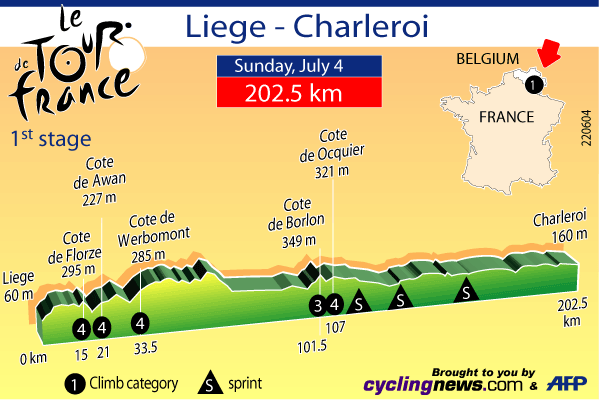 There are five climbs, all of the easy variety and concentrated in the early part of the stage. After coming out of the hills, there are three sprint awards at Modave (114.5 km), Wanze (132.5 km), and at Eghezee (158 km). |
Scratch everything I just did. I've reconsidered my approach somewhat. I've been trying to figure out the best way to represent these small hops which aren't normally covered in the game rules. I tried a rule of thumb that halved the climber ratings of the best climbers in the race to reduce the chance of someone like Armstrong getting KoM points on these short hills. However, after examining who got KoM points in the real first stage, it turns out there was an initial breakaway group that ran ahead and collected all the KoM points before being caught around 70 km from the finish. Therefore, I'll need to ponder a little more before deciding how to do this.
|
Quote:
Wolfpack, FWIW, this is almost always the case in every stage of the first week or so of the TdF. |
I was coming to that conclusion after looking at the other early stages. Turns out I had misread a rule regarding distance. I was reading it as "distance from finish" rather than "distance to finish", which is a big difference. One puts attack attempts at the start of the stage, the other puts it at the end of the stage. I'm still not totally satisfied though, as it looks like riders tend to breakaway on average about 10 km into a given stage, but the rules only provision a 2d6 read right-to-left, which means the absolute worst could be 11 km. I would think a 2d6 summed and added by 5 (which would mean an average break of 12 km) would be more accurate, at least for the first breakaway attempt of a stage. Problem is that he's got a breakaway chance rule that effectively negates a breakaway so soon into such a long stage. I'm thinking of altering that as well so that chances will occur.
|
OK, I think I've figured out how I'm going to work this. Most all the original game mechanics will still be the same, but I've tweaked them a bit and essentially created a subset of rules dealing with the first breakaway attempt of the stage (somewhere in the first 12 km). As to the climbs and sprints, if no breakaways occur, then I'm going to alter climber and sprinter ratings during the course of the stage to increase the likelyhood the same riders accumulate the points (in essence, they're riding at the front of the Peloton or even in a slight breakaway ahead of it, but in game terms, it's not significant enough to track independently).
So, with new changes in hand, we return to Liege, Belgium on July 4, 2004 and the beginning of stage one. |
(Stage one is being re-run with new game mechanics. Forget this and following posts ever existed.)
|
Quote:
|
Thanks. I'm already aware of the "three best" rule from the FAQ on the Tour de France website. What I was driving at was, say for example a rider completes a stage in 4 hours. He gets a 20 second bonus which effectively makes the time 3:59:40. Does that 20 second bonus count in team standings or is it 4 hours for the team? I suppose I could go to the TDF website and do some math, but I'm being lazy about it.
|
Never mind the question. I added up last year's times for Ag2r for the first two stages (because their rider won stage one in real life) and the times do not include any "bonuses" for sprints or finishes in the total. That's a good thing because it makes my job easier. Team standings will be posted momentarily.
|
Quote:
|
What have happend to the Danish team CSC?
|
How do you mean? Right now they're sitting in fourth in the team standings. Are you asking about specific riders?
BTW, I tried to run Stage 2 last night, but was unhappy with the outcome. I had another lone-rider breakaway that lasted virtually the entire stage, which I thought was unrealistic, especially for the distance involved, so I'm going to do some jiggering and do it again. If the rider had a 15 minute lead, I could go with it, but the math involved precludes that from ever happening. (Essentially, a lone rider will build up a lead equivalent to the point from the finish at which he made his breakaway, in seconds. E.g. a rider breaks away at 100 km to go. His maximum lead will be 100 seconds.) |
Quote:
That is indeed highly unrealistic. A lone rider precisely needs to be ahead by 15 minutes in order to even have a remote chance at winning... The scenario in your 1st stage would just never happen IRL. I know it's not your fault and the game's designed that way, I'm just saying... |
Thanks for the tip. Further jiggering and perhaps a re-run of the first stage may be necessary at this point, then.
Now that I read the rules a bit more closely, the wording in the instructions do not say how big a lead the rider ever achieved, but that that it is the time advantage when the peleton makes a serious attack to close the gap quickly. Therefore, I'm probably reading a bit too much into things. So, theoretically, Leipheimer could have had a very large lead at some point in the stage, but it was whittled down and then the Peloton made a strong push, but too late in the stage, to close the rest of the deficit. Needless to say, it means a blow-by-blow of flat stages is probably not the best way of describing it, since Leipheimer was probably much further ahead than I was describing him, but I don't have an idea how far ahead. I'll need to consider things some more before going forward. As a matter of fact, I had already worked out alternative methods for breakaways and peloton chases and was considering redoing stage one anyway. However, I may just scrap my redesign and stick with game mechanics and just have a recap of the stage rather than a blow-by-blow of the key points. Ruins the "as-it-happens" feel of things, but without knowing what the maximal buildup was, it's hard to be accurate about it. I suppose I could take the distance left and multiply by six (in Stage 1, this would have yielded a lead of 192.5*6=1155 seconds or 19:15 at maximum), which is what the lead time would be at the time of the Peloton's attack if there were six riders in the breakaway. How often do solo breaks occur and more importantly, how big do the leads get? I would gather they occur rarely and that leads shouldn't get that large because the rider is alone and therefore has to exert a lot of effort to build and maintain his lead. |
Quote:
Solo breaks are indeed fairly unusual. What you will get (at least in the early stages) is a fairly large group of riders, ten or a dozen or so, from many different teams and, a very important fact, riders that are not perceived as dangerous by the leaders. These guys will typically ride 10-15 minutes in front of a pack which rides 'slowly'. Near the end of the stage, say the last 50 or so klicks, depending on the distance, the sprinter teams will then decide to go and pursuit or let it be. They usually do pursuit and it is an impressive sight when you see roughly 15 guys riding full speed ahead and closing the gap on the poor tired guys in front... |
I've worked out a new process for flat stages. Does the following sound plausible? Bear in mind, we're using 2d6 read left-right rather than added in most of these situations.
A breakaway occurs and reaches a maximum time point, at which time, the peloton gradually reduces it to a managable deficit. If the distance left in the stage at the time of the breakaway is 132 km or more, the peloton will make a strong effort sometime between 77-132 km to catch up. Failing that, the peloton will make a second effort sometime between 11-66 km to catch up. Failing that, the breakaway riders succesfully keep whatever lead they have left to win the stage. If the breakaway comes with under 132 km to go, the peloton will only get one chance, between 11-66 km to go, to catch the breakaway. If the breakaway is caught by the peloton progressing at a certain rate, a new breakaway attempt is made, otherwise, the riders all advance as a peloton to the finish (I've tried to provision for the small chance that someone could make a push late, or is this unrealistic?). The reason I figured on a pair of attempts was because stage one in 2004 had the peloton catch the breakaway at 70 km, something that wouldn't be possible if the peloton started attacking at 66 km at best. Solo breakaways are still possible, but the odds are significantly better if those occur after 132 km to go since the peloton only has one chance to cut the lead down. It's a lot more math than the game designer had, but his way had the possibility of a rider breaking away at, say, 67 km (if all prior attempts failed, it could be done), but then the peloton would attack at 66 km if the dice rolled the right way. This would mean the attacker would get a 67 second lead in 1 km. Granted, the end result is the same and that an attack at 67 km would have been caught by a peloton chasing at 66 km, but the actual events surrounding breakaway and capture would have been totally bizarre. In the original rules, the attack starts at 67 km, builds a 67 second lead, then the peloton attacks at 66 km and catches the attacker at 32.9 km (((66*6)-67)/10). In my revised edit, the attack goes off at 67, the rider builds up a 6 second lead in half a kilometer before the peloton starts reeling in and then attacks at 66 km and captures the rider by 65.5 km. (There's a lot of math steps going on in my part that I'm leaving out to limit confusion and length.) Sounds reasonable? Alternately, there could be just one peloton attack at a distance of 45-100 km to go, succeed or fail, no new breakaways and no second chances for the peloton. |
Quote:
|
That's true. Leipheimer was a bit of a freakish roll. When determining breakaway riders, the odds are highly stacked for those who are known breakaway riders. There is a percentage chance (1-in-6) that the roll will send you to a different chart reading where you roll against all the key riders in the race (those that are basically part of every stage--flat, time trial, mountain) and it is here where Leipheimer's name came up. Even that was flukish because the key riders only have a small percentage of being chosen with the second roll (usually 1-in-36, such as Leipheimer), the vast majority going to further rolls to choose someone else left beyond the breakaway specialists and key riders (who only participates in the breakaway if someone from the first two groups does). After the riders are determined, there is another roll done for each rider to determine whether they got away successfully or not. Leipheimer rolled low and got away, while the other rider failed his breakaway chance and got caught. Thus, Leipheimer had a 1-in-216 chance of being selected for the breakaway and then had about 50/50 for the actual breakaway success. Basically it was 1-in-512 he got away.
At any rate, after some consideration, I'm leaning towards a "one chance" chase by the peloton starting at between 45-100 km to go. If the initial breakaway fails to occur (it could happen) until after 45 km to go, then the peloton chase will be between 11-66 km to go, which pretty much means it'll be a 50/50 chance that the peloton will immediately pounce on the breakaway and cut it off. |
I've continued to tinker with the system and have come to change a lot of what goes on, based on input from everyone here. Essentially, the only thing that's remained the same from the original rules is the selection of breakaway riders (simply because there's no evidence anything is unrealistic there, save perhaps that I can't really think of a time that Armstrong or Ullrich would attack on a flat stage, since they would rather do their attacks in the mountains, though their selection would again be a 1-in-216 chance).
The original rules allowed for a maximum of six attackers in a breakaway. I've changed that to eleven (sum 2d6, subtract 1). Breakaway riders now break as a group, rather than individuals (i.e. one breakaway check for all in a group, bonuses for average breakaway rating of group and group size). Also, the buildup and chase by the peloton is completely redone as I had previously described. Here is an example of stage one that I just rolled: Code:
Stage 1 (July 4, 2004)--Liege to Charleroi, 202.5 km(Do note that some of this math is base-6 math, so if you see "41-8 = 25", that's actually right. Subtracting 8 from 41 in base-6 results in 25.) |
A little more tinkering, a little more hacksawing. Sorry for the wait on getting this going again. At this point, I am going to redo stage 1 based on what the new mechanics for flat stages are. Stay tuned.
|
9 km
A pack of four riders makes a break for it. They are identified as Jens Voigt, Inigo Landlaluze, Juan Antonio Flecha, and Jacob Piil. However, the peloton recognizes the challenge presented by the breakaway riders and puts down the gears to bring them back into the group as they make the first climb of the day to the Cote de Florze. |
15 km
The peloton makes the first climb of the tour, the Cote de Florze. It's a 1.2 km climb over a 5% grade making it a Category 4. Right away, someone drops back of the Peloton and has to get assistance from the team car. It's Julian Dean (Credit Agricole), who seems to be having a lot of trouble with his bike. While he's getting work done, the Peloton moves on towards the top of the climb. As the riders come up to the line, one goes down fairly hard. It's Yuriy Krivtsov (Ag2r). He seems to be a little bloody and bruised, but is otherwise okay. He should be able to catch up with the Peloton on the next climb. As for this climb, the first one to crest the top and get the first King of the Mountain points of 2004 is...Axel Merckx (Lotto-Domo). A couple of wheel-lengths back is Richard Virenque (Quick Step) and in third is Ivan Basso (Team CSC). The riders now descend before beginning the next climb of stage one, ending on the Cote de Awan, six kilometers away. |
21 km
The peloton works its way up the Cote de Awan for the second climb of the day. This one measures out at 1.8 km over 4.1%, another Category 4. Just as his Ag2r teammates work Yuriy Krivtsov, bloodied knees and all back to the peloton, bad luck strikes his team for the second time today. This time, teammate Nicolas Portal suffers a tire flat. The support car comes along and supplies a new wheel, but he's out of the running for this climb as his teammates motor on without him. At the top, Axel Merckx continues to lead the charge, picking up his second straight King of the Mountain win. Just behind in second place is Denis Menchov (Banesto). Ag2r finally gets some good news as Laurent Brochard makes it into third place at the line and scores a point for himself. The peloton will continue on up the slope to the town of My and then descend to Fernieres at the base of the next climb, the Cote de Werbomont. |
33.5 km
The third climb of the day in just the first 33.5 km of the stage comes at the Cote de Werbomont. This is a 1.8 km climb with a 4.4% grade, making it a Category 4. The peloton chugs up the Cote de Werbomont. No casualties have occurred to the riders since the puncture by Nicolas Portal back at the base of the Cote de Awan. Julian Dean is still working to catch up to the peloton since his bike failure on the first climb. Otherwise, the gang's all here. This time a different set of three lead the peloton over the line. Michael Rasmussen (Rabobank) cranks out the effort and gets to the line first to earn three points. In second is...Jan Ullrich (T-Mobile), who seems to be putting forth a little bit of energy to send Armstrong a message that the Prologue will not be how he performs the entire Tour. Coming on his wheel for third is Jens Voigt (Team CSC). The peloton will continue to climb to Harre and then level off for a bit before climbing to the highest point on Stage 1, Samree at 529 meters, 59.5 km into the stage (26 km from here). They will then descend rapidly to La Rouche-en-Ardenne, dropping 300 meters in 9 km. From there, the course flattens considerably for about 30 km. There will be a food station at Rendeux-Bas. The riders will roll through Grandhan and arrive at Durbuy, where they will begin the toughest climb of the day, to the Cote de Borlon, 68 km from where they are now. |
40 km
As the riders crest the hill and come into My, Jens Voigt makes a break for it, but it isn't a good one and he is quickly reeled in. |
83 km
The rain is now coming down on the riders as they grab their food in Rendeux-Bas. Just east of the village, a trio of riders makes another attempt to get away. The riders are Paolo Bettini (Quick Step), Jakob Piil (Team CSC), and Juan Antonio Flecha (Fassa Bortolo). However, the Peloton is not in a giving mood today for whatever reason and the breakaway attempt is snuffed out. |
101.5 km
The toughest climb of the day has come for the peloton. The Cote de Borlon climb is 4.4 km in length over a 4.4% grade. Not a horrible climb, but it is a Category 3. Snagging first this time and getting four points for his effort is Laurent Brochard, giving him five total KoM points so far today. Axel Merckx comes in second, which isn't much of a surprise. What is is who he edged out in third...Lance Armstrong! Apparently he got Ullrich's message on the last climb and decided he'd answer back on the big climb of the day. Fourth place is awfully close between Thomas Voeckler (La Boulangere) and Mario Cipollini (Domina Vacanze). So close, in fact, that they will call it a tie and award both riders a point! No rest for the peloton, though. While they've topped the biggest climb of the day, their last climb now comes at them in just a few kilometers at the Cote de Ocquier. |
107 km
The final climb of the day arrives for the peloton, but one rider won't be joining it. Christophe Brandt (Lotto-Domo) suffers a flat. He's able to get a spare and get going again, but he won't be a factor in the climb. The climb itself is the Cote de Ocquier, a 1.4 km climb over a 4.4% grade, a Category 4. Axel Merckx continues to have a good day in the saddle as he racks up his third climbing victory in the five climbs of the stage and is going to be the first rider to wear the polka-dot jersey when Stage 2 goes off tomorrow. Coming in second is Giuseppe Guerini (T-Mobile) and the final KoM points of the day go to Denis Menchov (Banseto). With the climbs over with, the sprinters will now begin to assert themselves as there are three sprint checkpoints in the coming kilometers. First on the docket is the sprint line in Modave, about 7.5 km from the Cote de Ocquier. |
114.5 km
The riders continue on in the rain to Modave and the first intermediate sprint line. The slick roads, however, claim a victim. Gerrit Glomser (Saeco) loses control of his bike and goes down hard. He's a bit bloodied, but okay. However, he's effectively out of things for the moment. At the front, the sprinters, which had been shackled by the earlier climbs in the stage, now bring their talents to bear. Getting to the line first is...Stuart O'Grady (Cofidis). He edges out second place Jerome Pineau (La Boulangere) by nearly a full wheel-length. Coming in third is sprint master Robbie McEwen. All three pick up green jersey points, and more importantly, the equivalent time bonuses that will help them in the general classification standings. The peleton now rolls downhill towards the next sprint finish in the town of Wanze, 18 km away. Time is running out for a breakaway to occur. |
115 km
Just outside of Modave, a breakaway attempt is made. A trio of riders go for it. They are Fabian Cancellara (Fassa Bortolo), Egoi Martinez (Euskaltel), and Thomas Voeckler (La Boulangere). This time, the breakaway succeeds. The riders work together superbly and build up a substantial lead. They'll be comfortably ahead by the time the next sprint finsh comes in Wanze. |
132.5 km
In the 17 km since the breakaway, the three lead riders have managed to build up a three-minute lead on the peloton and are by their lonesome to contest the sprint points in Wanze. Getting to the line first is Cancellara, ahead by two-and-a-half wheel lengths of Martinez. Voeckler gets third. The peloton steams into Wanze without incident, but well back of the leading riders. The next sprint line is located in Eghezee, 22 km from Wanze. The leaders should be able to keep their lead through that point, but when and how the peloton will close is still unknown at this point. |
154.5 km
The lead group's lead has stabilized at around 4:00-4:10 over the last several kilometers, so the peloton will have some work to do if they want to catch up. At any rate, the trio of leaders come into Eghezee and this time, Martinez beats out Cancellara for the top honor with Voeckler again bringing up the rear of the group. Further back, Isidro Nozal (Liberty Seguros) develops mechanical problems with his bike and drops back of the peloton. He's going to have to get a new one, it seems, before he can go on. Meanwhile, the peloton peddles on, though at least the rain has stopped. The countdown now begins for when the peloton will make its gambit to catch the leaders. |
187.5 km
The peleton started making serious efforts to catch the leaders at about the 37 km mark. Since that time, they've taken a decent hunk out of the lead held by the head riders, cutting the lead in half by the time the lead group has reached the town of Farciennes, just 15 km from home. The peloton has really picked it up, though, in the last couple of kilometers and if they can maintain the pace, they have a chance of catching the leaders at the wire. |
201.5 km
The peloton continues its ruthless pursuit of the lead group and it looks like they'll be swallowed up just in time. The trio of riders has just passed under the 1 km banner, but nipping right on their heals are the lead sprinters from the peloton and they should catch the front runners very shortly. |
201.7 km (800 meters to go)
The breakaway is over. The peloton has finally caught the lead sprinters and now it'll be a dash to the finish contested by the lead sprinters of the peloton. So close, yet so far. |
202.5 km (Finish)
The sprinters are going like hell for the finish line now. At the end, a familiar face grabs first place. It's Robbie McEwen (Lotto-Domo), who picks up the 35 points and 20 second time bonus for first. He bests Thor Hushovd (Credit Agricole) by three-and-a-half wheel lengths. Another three wheel lengths back is Jean-Patrick Nazon (Ag2r), who nabs the final place on the podium over Stuart O'Grady. One rider suffers a terrible break in the midst of the run to the finish. Mario Cippolini gets a busted tire and watches helplessly as the peloton roars past. He is able to peddle his way through and get over the line, but at the back of the pack and his mechanic's going to have work to do tonight. |
Stage 1 Results
Code:
1 Robbie McEwen Lotto-Domo 4.40.27Overall standings after Stage 1 Yellow Jersey (Overall individual) Code:
1 Thor Hushovd Credit Agricole 4.47.15Green Jersey (Points) Code:
1 Robbie McEwen Lotto - Domo 37Polka-Dot Jersey (King of the Mountains) Code:
1 Axel Merckx Lotto - Domo 12White Jersey (Young Rider) Code:
1 Fabian Cancellara Fassa Bortolo 4.47.15Team Standings Code:
1 USPS 14.22.25 |
| All times are GMT -5. The time now is 02:28 PM. |
Powered by vBulletin Version 3.6.0
Copyright ©2000 - 2026, Jelsoft Enterprises Ltd.